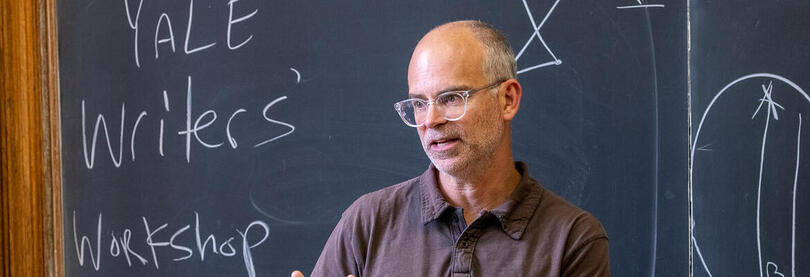
Yale Writers' Conference - 2013

Welcome to the Yale Writers’ Conference.

 We met for the first time in June 2012. After a competitive admissions process, one hundred and two students from four countries came to New Haven for ten days  dedicated to the craft and business of writing.

Since June, five students have published their first stories and poems; two have had plays produced. Another has finished her first book, and one has started her own writing workshop for returning veterans.   And many describe the Conference as the best experience of their writing lives.

Join us this summer!

 APPLY HERE: https://www.regonline.com/apply2013ywc

Applications received by Feb 15th – Decisions made by March 20

Applications received by March 31st – Decisions made by April 13

Click here to view the Tentative Schedule.

The Program

In its first  year, the YWC was a single ten-day program of workshops, master classes, individual conferences and readings. We will reprise its success in Session I for summer 2013. We have also added a second session this summer, three days devoted to specific genres.

Please understand that Session II is not a shorter version of Session I. The programs are completely different. Session I is devoted to the intensive development of writing skills. Session II is intended for writers to explore the issues inherent in specific genres.

Session I

June 10 - June 19

Session I is intended for writers  committed to developing their craft. It comprises small workshops, master classes and craft talks with visiting faculty, individual conferences, readings, and panel discussions with editors, publishers, and agents.

If you attend Session I you can expect face time with some of America’s best-known writers. You will work hard. And you will make friends with other writers who will support you for the rest of your career.

Workshops

The workshop is the heart of the program. It is led by a noted author who is also an experienced and accessible teacher. You and nine colleagues will spend every other morning in a session that may include assigned readings and exercises, but will focus on the discussion of student writing. All writers will submit their work a month before the program begins to permit in depth discussion in the workshop.

 Individual Conferences

Each writer will have an hour-long individual conference with his or her workshop leader. This will include discussion of the workshop submission as well as more general craft and career issues.

 The Master Class

Each visiting faculty will lead a master class limited to twenty-five writers admitted on a first come first served basis. The format will be determined by the faculty. In the afternoon, the visiting faculty will deliver a craft talk and discussion for the entire program. 

The Writing Life

We write in order to be read. Throughout the program we will present discussions with agents, journal and independent press publishers, and editors from major imprints. Some of our guests follow.

Agents: Lorin Reese, John Talbot

Independent Presses: Akashic Books, Bellevue Literary Press, Red Hen Press, Small Beer Press, Elephant Rock Books

Magazines: First Inklings, A Public Space

Editors: Elizabeth Beier (Saint Martin’s Press); George Gibson (Bloomsbury); Rebecca Salatan (Riverhead)

Session II

June 21 - June 23

 Session II is intended for writers who want to work on the questions specific to their chosen genres. Each section will include no more than twelve writers, led by faculty well known in the field. It will meet for three hours a day and may include assigned readings, but will focus on group discussion of participants' work. When not in sessions, faculty will meet with writers for individual conferences. Session II may also feature panel discussions on topics common to multiple fields as well as talks by agents and editors. Sections and their faculty are listed below, along with course descriptions.

Noir and Crime Fiction: Nathaniel Rich

The goal of this seminar is to give you a strong understanding of the basic techniques and stylistic forms used by writers of noir literature. In this context "noir literature" means crime fiction, written at its highest level. In preparation for the course you will be expected to read several novels and short stories, and you will write a story of your own. A list of assigned writers may include some of the following: Patricia Highsmith, James M. Cain, David Goodis, James Ellroy, Dashiell Hammett, Raymond Chandler, Chester Himes, and Jim Thompson.

Playwriting: Donald Margulies

Playwriting 101.  A crash course in the basic elements of dramatic writing: event, character, conflict, objective, negotiation, subtext.   Discussions will be supplemented by reading the work of contemporary playwrights like Pinter and Mamet.  Do not expect to workshop plays that have already been written.  This is intended as an introductory course for first-time playwrights or a refresher for those just starting out.    In-class and at-home writing exercises will culminate in the creation of ten-minute plays.

Screenwriting: Trey Ellis

The screenwriting program is intended for storytellers with little or no previous experience writing for the screen who are, however, hungry for an intensive workshop helping launch them toward a completed feature-length screenplay. Classes will focus on the peculiar  architecture of writing for the screen and how to mold that form in the service of creating irreplaceable characters, vibrant dialogue and compelling storytelling.  Those admitted must own screenwriting software.  

Writing for Television: Stephen Tolkin

Television writing has, with the profusion of cable networks, entered a new golden age. In this class, students will learn how to prepare a pitch, which is what a writer must do to sell her idea to a studio or network. To paraphrase Somerset Maugham, there are three characteristics shared by all good pitches. Nobody knows what they are. But there are elements, learned from years of experience, that we can impart. What “makes” a good idea? How to seek, beneath the surface of that good idea, the larger statement that the show can make? And how to orchestrate the presentation of that idea so it can have the maximum impact on a roomful of people with no attention span? Students will learn what makes a good character, and how to build one from the bottom up. They will also learn how to build an ensemble, as television, because of its intimacy, has always thrived in the characters that viewers take very personally to heart. Students will learn structure, how there are certain firm rules and no rules at all, and how one always has to walk the line between those two states. And they will write the first act, or first twenty pages, of a pilot script. 

 This class will not show you how to use a computer program so your script looks “professional”. It will not help you get an agent.

 It will show you that the most important element in good television writing is voice – your own unique way of seeing things, and dramatizing them on page and screen. The great series all share that one element. By the end of the class, you will have learned ways to access that voice, put it in a recognizable, hopefully sellable format. And then – you’re on your own.

Biography: M.G. Lord

The role of the biographer, Virginia Woolf once wrote, is to "admit contradictory versions of the same face."

This is also the biographer's greatest challenge--constructing a living (or once-living) person on the page, without reducing him or her to a single dimension.  This class will address the issues and techniques of biography, ranging from research to writing.  We will look at the structures of successful biographies, including the work of Leon Edel and Robert Caro.  And we will discuss ethical and legal concerns, including copyright restrictions on unpublished material and the privacy rights of nonpublic figures. 

Expatriate Fiction: Marc Fitten

Place is a character all its own and the expat writer enjoys the unique advantage of experiencing culture from the outside.  The purpose of the expat ficton seminar is to provide an understanding of place and character from the outsider's point of view.  Class will focus on how the writer might approach international subject matter and render it artfully on page.  Reading selections from Twain, Miller, Hemingway, and others will be included.  Passages will be written in an attempt to build a realistic global set.

Science Fiction and Fantasy: John Crowley

3-time World Fantasy Award winner John Crowley teaches an intensive mini-course in Writing Fantasy and Science Fiction.  The two genres ought to be opposites -- one is about worlds that can't exist, and the other is about worlds that might -- but we all know they DO go together:  they are both realms of romance.  Students will do in-class exercises in the special language of these genres, study some revealing examples, and workshop one piece of their own.  Discussion subjects will include taxonomies of fantasy, SF and science, the universe of romance, reading like a writer rather than a fan, and the fantasy/SF market today.  

Science Writing: Steve Olson

This section of Session II is for practicing science writers, for writers drawn to science, and for scientists with a strong interest and some previous experience in writing. We will use A Field Guide for Science Writers, which will be sent to registrants before the session, to cover the basic aspects of the field. But our broader interests will be in the elements that unite good science writing with all good writing:  structure, tone, and perspective. Science writing has to both explain and entertain, which means that science writers need to tell stories that remain grounded in the world of empirical experience.


Historical Fiction: Hope Dellon

"Historical fiction is a hybrid form, halfway between fiction and nonfiction. It is pioneer country, without fixed laws. To some, if it is fiction, anything is permitted. To others, wanton invention when facts are to be found, or, worse, contradiction of well-known facts, is a horror: a violation of an implicit contract with the reader, and a betrayal of the people written about. Ironically, it is when those stricter standards of truth are applied that historical fiction looks most like lying."
--"The Dead are Real: Hilary Mantel's Imagination," Larissa MacFarquhar, The New Yorker, October 15, 2012

What is truth in historical fiction, and does it matter? How can a novelist find the ideal balance between fact and fiction, research and storytelling? What are the pleasures and pitfalls of biographical fiction vs. stories of invented characters set against an historical background? How can a writer best reconcile inconvenient facts, not to menton attitudes and beliefs long out of favor, with a good story? Is there a cut-off date between historical and contemporary fiction (WWII? Vietnam? The turn of the 21st century?).... In this session we will focus on these questions and many others. Attention will definitely be paid to Hilary Mantel and to other historical novelists participants may particularly love or hate, as well as to the writers' own work. 


Literary Discourse: Criticism and Review: Je Banach

What is literary discourse? Why do we need literary criticism? What makes up a good review? These are just a few of the questions writers will consider as we examine the move from the private experience of reading to the public experience of writing about that which we have read. Considering examples from Aristotle's Poetics to the present day, we will discuss issues of consensus and controversy. Writers will engage in a thoughtful and expansive dialogue about the challenges, the rewards, and the purpose of writing about literature and will leave equipped with the tools necessary to carry them from preparation to publication of strong and engaging criticism and review.

Revision and Submission: Jotham Burrello

This section is designed for writers ready to tinker, tighten and sharpen a short story or essay for submission. Writers put a completed draft through rounds of revision—revising and re-imagining—using a combination of journaling, exercises, read-alouds and a workshop session. Come ready to roll up your shelves as we juggle regimented work and further play, and learn revision strategies to file in your writer’s toolbox. Day three includes an overview on the literary marketplace. Participants receive the revision DVD, “So, Is It Done?” produced by writer, teacher and publisher Jotham Burrello, the facilitator for this session. 

Poetry: Stephanie Hart

The goal of this seminar is to develop the poet’s ability to create vibrant imagery, effective line breaks and line integrity as well as make communicative language choices. Focusing on these basic elements will strengthen the work of both new and experienced poets.  In-class exercises will not only generate material to manipulate in service of these goals but also introduce a random element to help access new areas of exploration. Homework assignments will further develop the material begun in class. Workshops will focus on the resulting poems and, if time permits, students will have the option of workshopping poems they have written before taking this seminar. These workshops will help students to discover pleasure in revision and in abandoning, at times, one’s original conception for a poem. Individual conferences will further these goals and give students the opportunity to talk privately about their work.

Children's and Young Adult: Laurel Snyder

The Wild Ride:  writing for children and young adults. “You have to write the book that wants to be written. And if the book will be too difficult for grown-ups, then you write it for children.” ~Madeleine L’Engle

Books for children and young adults vary wildly, from fantasy romps to gothic thrillers to achingly realistic love stories.  What unifies them is often their intensity—their willingness to go further.  They can be expansive, brutal, or hilarious in their approaches, but they are almost never dull. 

While such books can be amazing fun to write, they pose certain challenges.  How do we know when we’ve gone too far?  When does our character become unbelievable or inauthentic?  When does our world-building begin to distract our reader?  Are there limits to how dark or mature a book for teens should be?  How much do we really need to think about logic in a magical world?

In this session we’ll work on the craft of fiction, and discuss the basic elements of the novel.  We’ll talk about the particularities of the market, and how to get a book ready for submission. But we’ll pay particular attention to these important questions of intensity, and to that elusive thing we call tone, which is so often part of the answer.   

 Flash Fiction: Molly Gaudry

Flash fiction has all the essential elements of longer fiction: character, setting, plot, and narrative -- but the goal is to distill these down to a single dramatic moment, the story's reason for existing at all. In this course, we'll read and write flash fiction, or stories and prose poems under 1,000 words. We will also learn about several literary journals and book publishers that consistently publish the best flash fiction and prose poems.

Family History: Eileen Pollack

Where do you start in writing about your family and its history? How do you flesh out, verify, or disprove what you know (or think you know) about the stories that have been handed down to you? How do you focus and select and shape your material? Are you writing for yourself? Your descendants? A larger public? How can you make your family's story meaningful to readers who've never met any of you (and might not care to)? Where does your family's history intersect with the larger history of your hometown, your state, your native country? And last but not least, how do you write (and perhaps even publish) your family's story without alienating your parents, grandparents, aunts, uncles, cousins, sons, daughters, brothers, sisters, and siblings?

Our faculty are accessible teachers as well as accomplished writers. Along with classroom and conference time, they will be available to writers in the dining hall during lunch and around the college throughout the day.


FACULTY - SESSION I

Our visiting authors will each spend an entire day with the program. The 2013 visiting faculty will include:

Tom Perrotta, whom the New York Times has called "The American Chekhov," is the author of The Leftovers; Election, and Little Children. His screenplay for Little Children was nominated for the Oscar and the Golden Globe. He is now developing The Leftovers for HBO.


Richard Selzer, formerly a practicing general surgeon, is a critically acclaimed author of essays, memoir, and short stories whose reflections on medicine have made his work required reading in many medical schools. His collection, The Doctor Stories, was a finalist for the PEN/Faulkner Award; his other work includes Confessions of a Knife; Letters to a Young DoctorDown from Troy and Diary.


Susan Orlean is the bestselling author of eight books, including The Bullfighter Checks Her Makeup; My Kind of Place; Saturday Night; and  Lazy Little Loafers. In 1999, she published The Orchid Thief, a narrative about orchid poachers in Florida, which was made into the Oscar-wining movie, Adaptation, written by Charlie Kaufman and directed by Spike Jonze.  Her 2011 book, Rin Tin Tin: The Life and the Legend, an account of Rin Tin Tin’s journey from orphaned puppy to international icon, was a New York Times bestseller and a New York Times Notable book.  It won the Ohioana Book Award and the Theatre Library Association’s Richard Wall Memorial Award.

Orlean has been a staff writer for the New Yorker since 1992. Her subjects have included umbrella inventors, origami artists, skater Tonya Harding, and gospel choirs.  She has also written extensively about animals, including show dogs, racing pigeons, animal actors, oxen, donkeys, mules, and backyard chickens. Her work has also been published in Esquire, Rolling Stone, Outside, Smithsonian, and the New York Times.

Orlean graduated with honors from the University of Michigan and was a Nieman Fellow at Harvard University in 2003. In 2012 she received an honorary Doctor of Humane Letters from the University of Michigan.  She has served as a judge for the National Book Awards, the Associated Writing Program literary awards, the Bakeless Prize, the Bellevue Literary Awards, and the Iowa Review literary award. She lives in Los Angeles and in upstate New York with one dog, three cats, eight chickens, three ducks, and her husband and son.

ZZ Packer  was born in Chicago, Illinois and raised in Atlanta, Georgia and Louisville, Kentucky. She currently lives in Austin, Texas. Her stories have appeared in The New Yorker, Harper’s, Story, Ploughshares, Zoetrope All-Story and Best American Short Stories 2000, Best American Short Stories 2003 and NPR’s Selected Shorts Series. Her non-fiction has appeared in the New York Times Magazine, Essence, O Magazine and The New York Times Book Review. She is the recipient of a Rona Jaffe Foundation Writer’s Award, a Whiting Award, and a Guggenheim Fellowship. Her book Drinking Coffee Elsewhere won the Commonwealth First Fiction Award, and an ALEX award. It became a finalist for the PEN/Faulkner award and was selected for the Today Show Book Club by John Updike. She is currently at work on a novel about the Buffalo Soldiers, entitled The Thousands, an excerpt of which appeared in The New Yorker’s 20 Under 40 Fiction Issue under the title Dayward.


Kevin Wilson 
is the author of the collection Tunneling to the Center of the Earth (Ecco/Harper Perennial, 2009), which received an Alex Award from the American Library Association and the Shirley Jackson Award, and a novel, The Family Fang (Ecco, 2011).  His fiction has appeared in Ploughshares, Tin House, One Story, Cincinnati Review, and elsewhere, and has appeared in four volumes of the New Stories from the South: The Year’s Best anthology as well as The PEN/O. Henry Prize Stories 2012.  He has received fellowships from the MacDowell Colony, Yaddo, and the KHN Center for the Arts.  He lives in Sewanee, Tennessee, with his wife, the poet Leigh Anne Couch, and his sons, Griff and Patch, where he is an Assistant Professor in the English Department at the University of the South.

 Residential Faculty

Director

Terence Hawkins is the author of The Rage of Achilles and numerous short stories. He is also a trial lawyer in New Haven.


Fiction:

Our fiction faculty are writers and teachers of the first rank. Their workshops will address issues common to all forms and genres. 

Sybil Baker was named one of "today's strongest emerging talents in literary fiction and poetry" by the Huffington Post. She is the author of The Life Plan; Talismans; and Into this World. She teaches at the University of Tennessee at Chattanooga as well as in the City University of Hong Kong's MFA program. Recently she was a Visiting Writer at the American Writers Festival in Singapore, where she was awarded the National Critics Choice Best New Cross Cultural Literary Fiction and Poetry Writer of the Year. A recipient of Chattanooga's MakeWork Grant, she is Fiction Editor at Drunken Boat.


Kirsten Bakis
 is the recipient of a Whiting Award, a Michener/Copernicus Society of America grant, and a Teaching/Writing Fellowship from the Iowa Writers' Workshop. Her novel Lives of the Monster Dogs, a New York Times Notable Book of the Year, won the Bram Stoker Award for First Novel and was shortlisted for Britain's prestigious Orange Prize. 


Trey Ellis is a novelist, screenwriter, playwright, essayist, and an Associate Professor in the Graduate School of the Arts at Columbia University.  He is the author of the novels, Platitudes, Home Repairs, and the American Book Award-winning, Right Here, Right Now, as well as the memoir Bedtime Stories: Adventures in the Land of  Single-Fatherhood.  His work for the screen includes the Emmy- nominated Tuskegee Airmen, and Good Fences which was shortlisted for the PEN Award for Best Teleplay of the year.  His essays have appeared in the New York Times, Playboy, the Washington Post, the Los Angeles Times, GQ, and Vanity Fair, and he has contributed audio commentary to NPR’s All Things Considered. His first play, Fly, was performed at the Lincoln Center Institute and later this year at Washington, D.C.’s historic Ford’s Theater. He is also a frequent and longtime political blogger on the HuffingtonPost.

Marc Fitten has published opinion pieces in the New York Times, the International Herald Tribune, and the Atlanta Journal-Constitution. His debut novel, Valeria's Last Stand, was published in ten countries, was an Amazon Best of the Month for May 2009, held a spot on Der Spiegel's bestseller's list for seven weeks, and was a finalist for the Exclusive Books Boeke Prize in South Africa. Booklist wrote of the book, "Evoking Gogol, Kundera, and Garcia Marquez, with a touch of Fellini for good measure, Fitten concocts a shrewdly farcical tale of the endless battle between change and tradition." His second novel, Elza's Kitchen, was released in July 2012. 

Nathaniel Rich is the author of two novels: Odds Against Tomorrow, which will be published in April by Farrar, Straus and Giroux, and The Mayor's Tongue. He is a frequent contributor to the New York Times Magazine, Harper's, and the New York Review of Books.


Marian Thurm is the author of three short-story collections and six novels; her novel The Clairvoyant was a New York Times Notable Book. Her short stories have appeared in the New Yorker, the Atlantic, Michigan Quarterly, Boston Review, Ontario Review, and many other magazines, and have been included in Best American Short Stories and numerous other anthologies. She has taught creative writing at Barnard, Columbia, and Yale.

Sergio Troncoso is the author of From This Wicked Patch of Dust, which Kirkus Reviews called "an engaging literary achievement" in a starred review.  The novel was selected by Southwest Books of the Year as a Notable Book.  Troncoso also wrote Crossing Borders: Personal Essays, which won the Bronze Award for Essays in ForeWord Review's Book of the Year Awards.  He is also the author of The Nature of Truth and The Last Tortilla and Other Stories, which won the Premio Aztlan Literary Prize and the Southwest Book Award.  In 2012, he was inducted into the Texas Institute of Letters.

Je Banach, a recipient of the New Boston Fund Fellowship in fiction, has written for Esquire, Granta, Guernica, Bookforum, KGB Bar Lit, Opium, and other venues. She was awarded a residency in fiction at Hunt Hill Farm, an affiliate of the Smithsonian Institution. She has also held informal residencies at Dorset Colony in Dorset, VT, and The Norman Mailer Writers Colony in Provincetown, MA. Banach has been a long-time contributor to Harold Bloom’s literary series with Infobase Publishing and is the author of guides to classics as well as works by contemporaries such as Salman Rushdie, Hisham Matar, E. L. Doctorow, Yann Martel, and David Mitchell, among others. She is currently engaged in a collaboration with Jonathan Lethem and other fiction projects.

Nahid Rachlin attended Columbia University MFA program on a Doubleday-Columbia Fellowship and then went on to Stanford University MFA program on a Stegner Fellowship. Her publications include a memoir, Persian Girls (Penguin), four novels, Jumping Over Fire (City Lights), Foreigner (W.W. Norton), Married To A Stranger (E.P.Dutton-City Lights), The Heart's Desire (City Lights), and a collection of short stories, Veils (City Lights). Her individual short stories have appeared in more than fifty magazines, including the Virginia Quarterly Review, Prairie Schooner, Redbook, and Shenandoah. One of her stories was adopted by Symphony Space, “Selected Shorts,” was read at the Getty Museum, LA, and was aired on NPR around the country. Her work has been translated into Portuguese, Polish, Italian, Dutch, Arabic, and Persian. She had received a Bennet Cerf Award, PEN Syndicated Fiction Project Award, and a National Endowment for the Arts grant.

NonFiction:

These workshops will explore the ways in which writers use their personal stories to comment on aspects of the wider world.

MG Lord is the author of  Forever Barbie: The Unauthorized Biography of a Real Dolland Astro Turf: The Private Life of Rocket Science, a family memoir of aerospace culture during the cold war.  She is a frequent contributor to the NY Times Book Review; her work has appeared in Discover, The New Yorker, Los Angeles, Travel + Leisure, ArtForum and other publications.  She has been awarded artistic residencies at Yaddo and the MacDowell Colony, as well as an Alfred P. Sloan Foundation science-writing grant.  She teaches writing at USC.  Her most recent book, The Accidental Feminist: How Elizabeth Taylor Raised Our Consciousness and We Were Too Distracted by Her Beauty to Notice, won the Los Angeles Press Club National Entertainment Journalism Award for the best book published on an entertainment subject in 2012.

Eileen Pollack is the winner of the Edward Lewis Wallant Award, former director of the MFA program in writing at the University of Michigan, and author of In the MouthWoman Walking Ahead, Breaking and Entering and Creative Nonfiction.


Jotham Burrello is an arts entrepreneur—writer, publisher, editor, video and radio producer, and creative writing instructor at Columbia College Chicago, where he created and now directs the Publishing Lab, a resource for emerging writers, and the Review Lab, an online forum for reviewing and writing. In 2010 he founded Elephant Rock Books, an award-winning press of fiction and nonfiction. With Janet Burroway, he co-wrote and produced the instructional DVD, So, Is It Done? Navigating the Revision Process, and Submit! The Unofficial Guide to Submitting Short Prose. His writing has appeared in literary journals and the Christian Science Monitor. He is the former editor of Sport Literate, a journal of creative nonfiction. Burrello lives (and drives a tractor) on Muddy Feet Flower Farm in Ashford, CT.


FACULTY - SESSION II

 Science Fiction & Fantasy

John Crowley is a three-time winner of the World Fantasy Award, recipient of an American Academy of Arts and Letters Award for Literature, author of the AegyptCycle, Lord Byron's Novel, and Little, Big.


Science Writing

Steve Olson is the author of Mapping Human History: Genes, Race, and Our Common Origins (Boston: Houghton Mifflin), which was one of five finalists for the 2002 nonfiction National Book Award and received the Science-in-Society Award from the National Association of Science Writers. His book Count Down: Six Kids Vie for Glory at the World’s Toughest Math Competition (Boston: Houghton Mifflin) was named a best science book of the year by Discover magazine. His most recent book, co-written with Greg Graffin, is Anarchy Evolution: Faith, Science, and Bad Religion in a World Without God (New York: HarperCollins). He is the author of articles in the Atlantic Monthly, Science, Smithsonian, Seed, the Washington Post, the Los Angeles Times, Scientific American, Wired, the Yale Alumni Magazine, the Washingtonian, Slate, Astronomy, Science 82-86, and many other magazines. In September 2004 he published with two coauthors a research article in Nature that presented a fundamentally new perspective on human ancestry. From 1989 through 1992 he served as Special Assistant for Communications in the White House Office of Science and Technology Policy. He earned a bachelor's degree in physics from Yale University in 1978.

Children's and Young Adult

Laurel Snyder is the author of many books for young readers, most recently a novel, Bigger than a Bread Box (Random House Books for Young Readers, 2011) and the forthcoming picture book, The Longest Night (Schwartz & Wade, 2013).  A graduate of the Iowa Writers’ Workshop and an occasional commentator for NPR’s All Things Considered, Laurel also writes poems and essays for adult readers.  She lives in Atlanta and online at http://laurelsnyder.com


 Historical Fiction

Hope Dellon is an executive editor at St. Martin’s Press in New York. Her parents, who met while pursuing advanced degrees in history, were eager to pass their love of the subject along to their children via dinner-table conversations and enthusiastic visits to small-town historical societies. This unfortunately backfired with Hope, who avoided the formal study of history as much as she could, though she did find herself drawn to fiction set in other eras. After graduating from Yale with a B.A. and an M.A. in English in 1975, she joined St. Martin’s Press, where she has acquired and edited such historical fiction as The Autobiography of Henry the VIII: With Notes by His Fool, Will Somers, by Margaret George;  The Winter King trilogy by Bernard Cornwell; Moloka'i, by Alan Brennert; Past Imperfect, by Julian Fellowes; the samurai thrillers of Laura Joh Rowland; The American Heiress, by Daisy Goodwin; and Therese Anne Fowler's forthcoming Z: A Novel of Zelda Fitzgerald, which recently received a starred Kirkus review: "Fowler's Zelda is all we would expect and more...a lovely, sad and compulsively readable book." Virtually everything Hope knows about history she learned from novels.

Playwriting

DONALD MARGULIES's plays include Time Stands Still; Brooklyn Boy; Dinner With Friends; Sight UnseenCollected Stories; The Loman Family Picnic; God of Vengance; What's Wrong With This Picture?; Found A Peanut; The Model Apartment; Shipwrecked! An Entertainment - The Amazing Adventures Of Louis deRougemont (As Told By Himself); Coney Island Christmas and the upcoming The Country House.

He has won a Lucille Lortel Award, two American Theatre Critics New Play Citations, two Los Angeles Drama Critics Awards, two OBIE Awards, one Tony Award nomination, two Dramatists Guild Hull-Warriner Awards, five Drama Desk Award nominations, five Burns Mantle Best Play citations, two Pulitzer Prize nominations and one Pulitzer Prize.  His works have been performed on and off Broadway and at major theatres across the United States and around the world.  Mr. Margulies has received grants from the National Endowment for the Arts, The New York Foundation for the Arts, and the John Simon Guggenheim Memorial Foundation.  In 2005 he was honored by the American Academy of Arts and Letters with an Award in Literature, and was the recipient of the 2000 Sidney Kingsley Award for Outstanding Achievement in the Theatre.  Mr. Margulies is an alumnus of New Dramatists and serves on the council of The Dramatists Guild of America.  He is an adjunct professor of English and Theatre Studies at Yale University.

Flash Fiction

Molly Gaudry is the author of the verse novel We Take Me Apart, which was shortlisted for the 2011 PEN/Joyce Osterweil and named 2nd finalist for the 2011 Asian American Literary Award for Poetry. Her most recent collection, Lost July, appears in the 3-author volume Frequencies, which includes a collection from Bob Hicok. She holds an MA in fiction from the University of Cincinnati, and an MFA in poetry from George Mason University. She is the Creative Director at The Lit Pub

Poetry

Stephanie Hart  holds a BA in English from Barnard College and an MFA in Poetry from the Writing Division of the School of the Arts at Columbia University. She has studied with poets Allen Ginsberg, Derek Walcott, and Daniel Halpern, among others. She has many years of teaching experience, including nearly 20 years at Yale’s English Language Institute. Currently, she is Professor of English at Housatonic Community College in Bridgeport, CT, where she has served as the Chairperson of the Humanities Department and teaches composition, literature, and creative writing.

 Poetry

Richard Jackson has been awarded the Order of Freedom Medal by the President of Slovenia for literary and humanitarian work in the Balkans, and has been named a Guggenheim Fellow, Fulbright Fellow, Witter-Bynner Fellow, NEA fellow, NEH Fellow, and has lectured and given readings at dozens of universities and conferences in the U.S. and abroad. In 2009 he won the AWP George Garret National Award for Teaching, Writing and Arts Advocacy, and has had 5 Pushcart Prize Poem appearances. He leads a group of writing students to Europe each May. teaches creative writing, poetry, and humanities in UTC's interdisciplinary honors program, and is a frequent guest lecturer at the MFA writing seminars at Vermont College, University of Iowa Summer Writers' Festival, and the Prague Summer Program.

He is the author of ten books of poems including Resonance ( 2010) (Eric Hoffer Award), Half Lives: Petrarchan Poems (2004) and Unauthorized Autobiography: New and Selected Poems (2003). He has also published two books of translations, Last Voyage: The Poems of Giovanni Pascoli from Italian (2010) and Alexandar Persolja's Journey of the Sun from Slovene (2008). He is also the author of two critical books, Acts of Mind: Conversations with American Poets (Choice Award) and Dismantling Time in Contemporary Poetry (Agee Award Winner), and has edited two anthologies of Slovene poetry, as well as the journal Poetry Miscellany. His work has been translated into fifteen languages and has appeared in The Best American Poems, among other collections.

Writing for Television

Stephen Tolkin trained as an architect at Yale. After a year of drafting plumbing details in various glamorous offices on two continents, he gave it all up and went into the family business of writing in Hollywood. He has created four network series, including WB’s Summerland; written and produced Brothers & Sisters and TNT’s current hit series Perception; and written and directed miniseries and cable movies for Lifetime (starring Gena Rowlands), USA (Christine Lahti), HBO (Cuba Gooding Jr.), and Showtime (Gael Garcia Bernal).

Writing for Television

Richard Kramer is the award-winning writer/producer/director of such shows as thirtysomething, My So-Called Life, Once and Again, and Tales of the City.  He spent four years in Silliman College many, many years ago. At the end of 2012, he published his first novel These Things Happen, which he is presently adapting for television.

The following faculty are also teaching in Session I.  For their biographies, please see above.

Criticism and Review - Je Banach

Expatriate Fiction - Marc Fitten 

Noir and Crime Fiction - Nathaniel Rich 

 Screenwriting - Trey Ellis

Revision and Submission - Jotham Burrello 

Biography - MG Lord

Family History- Eileen Pollack

Yale and New Haven:

Accommodation & Facilities

Writers and faculty alike will live in one of Yale’s  residential colleges. They will share breakfast and lunch in the dining hall. The food features organic and locally sourced selections and a wide variety of choices at each meal. Bedrooms are single occupancy but share a common living space and bathroom with writers of the same gender. Please bear in mind that even though it is a striking setting, it is a college dorm and not a hotel. Writers who prefer air conditioning and housekeeping services should consider staying in one of the local hotels that has offered our participants a discount.

While breakfast and lunch are included in tuition, dinner is on your own. We  encourage you to explore downtown New Haven and its dozens of excellent restaurants.

Our writers have access to the entire Yale campus. This includes one of the world’s largest gymnasiums as well as some of the country’s largest libraries. The Yale Art Gallery, including its recently renovated sculpture hall, was renowned architect Louis Khan’s first major commission; his last, the British Art Center, is directly across the street. 

APPLY HERE:  https://www.regonline.com/apply2013ywc

Applications received by Feb 15th – Decisions made by March 20

Applications received by March 31st – Decisions made by April 13

Total conference  size is limited to one hundred and thirty.

In Session I, each workshop will be limited to ten writers. The master class is limited to twenty-five. Each section in Session II includes no more than twelve writers

Admissions are based solely on the writing sample. The writing sample needs to accompany your application for admission, and may be uploaded electronically. It should not exceed thirteen hundred words.  Please double space your writing using a 12 pt. font as a Word or PDF document. Each page must include your name.   

Once accepted, an applicant is not considered registered until payment has been received. We accept payment through both check and PayPal.

Writers are assigned to workshops and master classes in the order in which they register. While we will make every effort to honor your faculty preference, we cannot guarantee it, because we can’t assign you to a workshop that has been filled. We will, however, announce the closing of a workshop immediately on our website to give you an opportunity to make another selection.

You can apply for either or both Sessions I and II.

Applicants must be 18 years old by the start of the program.


Costs: 

June 10 - June 19

Session 1 (Living in residential college): $2400 

Session 1 (Not living in residential college): $1850
 

June 21 - June 23

Session 2 (Living in residential college): $800

Session 2 (Not living in residential college): $635 


June 10 - June 23

Both Sessions (Living in residential college): $3255 

Both Sessions (Not living in residential college): $2485

Only credit cards are accepted for the application fee. Upon acceptance the program fees can be paid via credit card or check. Check should be made payable to Yale University and mailed to Yale University, PO Box 208355, New Haven, CT 06510. If paying by credit card, you will be charged within a few days of registration.  Program fees are due in full within two weeks of acceptance or your space may be forfeited. We will refund 75% for cancellation requests received by April 15, 2013 and 50% for cancellation requests received by May 15, 2013.   We will be unable to honor refund requests after then.